


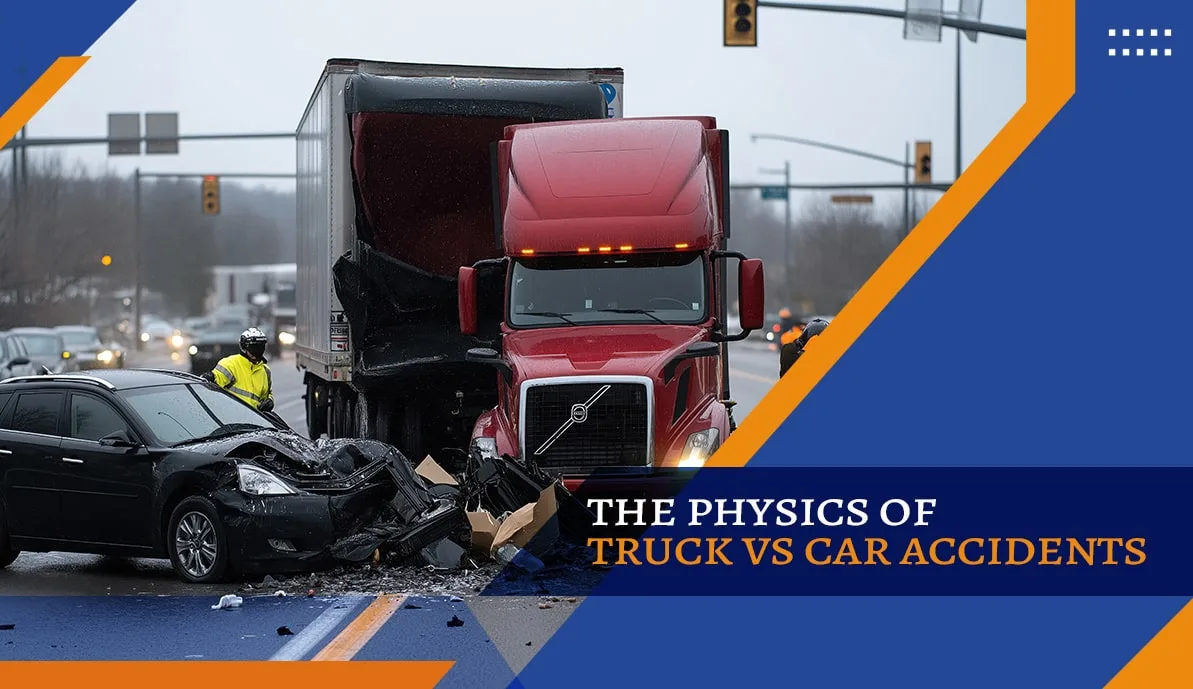
Short answer: truck vs car accidents are so severe because of physics. A loaded tractor-trailer can weigh up to 80,000 pounds, roughly 25 times as much as a typical car, and the energy of the crash goes mostly into the smaller vehicle. According to IIHS data for 2023, 65% of the people killed in large truck crashes were occupants of cars and other passenger vehicles, while 16% were truck occupants (IIHS).
The same science helps prove fault in a legal claim. Our truck accident attorneys represent injured drivers and families in Florida, and this is general information, not legal advice.
The Physics of a Truck vs Car Crash
Mass and momentum
Momentum is mass times velocity, and a truck carries far more of it than a car, even at lower speeds. In a collision the force on each vehicle is equal and opposite, but the lighter car changes speed much more. That is why the car is pushed, crushed, or spun while the truck keeps moving.
Kinetic energy
Kinetic energy grows with the square of speed. A truck at 60 mph carries far more energy than a car at 60 mph, and that energy has to go somewhere, usually into the smaller vehicle and its occupants.
Stopping distance
A loaded truck needs much more distance to stop than a car, so a late reaction by a truck driver matters. Often it is not speed alone but delayed braking that decides how hard the impact is.
Height and underride
A truck’s frame sits high off the ground. In a rear-end crash a car can slide under the trailer, bypassing crumple zones and airbags. Federal rules generally require rear underride guards on trailers but not side guards, which is why side underride crashes are especially dangerous.
| Factor | Truck | Car |
| Weight | Up to 80,000 lbs loaded | About 3,000 to 4,000 lbs |
| Result of a collision | Keeps moving | Pushed, crushed, or spun |
| Stopping distance | Much longer | Shorter |
| Height | High frame can override a car’s crumple zones | Low, so it can slide under a trailer |
| Blind spots | Large on all four sides | Smaller |
| Deaths in large truck crashes (2023) | 16% truck occupants | 65% passenger vehicle occupants |
Why Truck Crash Claims Are Different
- Federal safety rules apply. Commercial drivers are subject to hours-of-service limits, which generally cap driving at 11 hours within a 14-hour window, along with inspection and maintenance rules.
- More than one party may be responsible: the driver, the trucking company, a cargo loader or shipper, a maintenance provider, or a manufacturer.
- Bigger insurance, tougher defense. Many commercial trucks must carry at least $750,000 in liability coverage, and carriers often send investigators to the scene within hours.
- Evidence can disappear. Black box and electronic logging data may be kept for only about six months, so a preservation request should go out early.
Learn more in our guides on why truck accident cases differ from car accident cases and how black box data can help your case.
Hurt in a truck crash? Tell us what happened, and an attorney will review your situation for free.
How Science Becomes Evidence in a Truck Accident Claim
- Accident reconstruction. An expert uses skid marks, vehicle damage, and final rest positions to estimate speed, angle, and braking.
- Engine and logging data. This can show speed, braking, and whether the driver exceeded hours-of-service limits.
- Dash camera and traffic camera video, where it exists.
- Inspection and maintenance records for brakes, tires, and the trailer.
This evidence can answer an argument that the car driver “cut off” the truck, and it can connect the way the crash happened to the injuries suffered.
Florida Basics After a Truck Crash
- PIP pays first, up to $10,000, if you get treatment within 14 days (Statute 627.736). Beyond that you can pursue the at-fault parties, and pain and suffering requires your injury to meet the serious injury threshold (Statute 627.737).
- Shared fault reduces your recovery. Under Florida’s modified comparative negligence rule (Statute 768.81), you are barred only if you are found more than 50% at fault.
- The deadline is two years for most negligence claims (Statute 95.11).
For what to do and what to expect, read steps to take immediately after a large truck crash, how long a truck accident case takes, and what damages you can recover.
Example: How a Truck Crash Claim Can Unfold
This is an illustrative scenario, not a past client case. A driver is rear-ended by a tractor-trailer on I-4 near Orlando. The trucking company’s insurer says the car stopped suddenly. A lawyer sends a preservation request for the truck’s electronic data and logs, and a reconstruction expert shows the truck was following too closely at a speed that left too little room to stop. Moving quickly keeps the key data from being overwritten.
What to Do After a Truck Crash
- Call 911 and get medical care within 14 days, even if you feel fine.
- Photograph the scene, the truck’s markings and license plate, and your injuries.
- Do not give a recorded statement to the trucking company’s insurer.
- Keep your vehicle unrepaired until it has been documented.
- Talk to a lawyer early, before you sign anything or accept an offer.
Ready to talk to someone about your truck crash?
Evidence like black box and logging data can be overwritten, so it helps to act early. Fill out the short form and our team will follow up.
Frequently Asked Questions
Why are truck vs car accidents so much more severe than car vs car crashes?
A loaded tractor-trailer can weigh up to 80,000 pounds, about 25 times as much as a typical car. In a collision the forces on both vehicles are equal and opposite, but the car changes speed far more and its occupants absorb most of the harm. A truck’s height can also bypass a car’s crumple zones.
Who is most often killed in large truck crashes?
Mostly people in other vehicles. According to IIHS data for 2023, 65% of people killed in large truck crashes were occupants of cars and other passenger vehicles, 16% were truck occupants, and 17% were pedestrians, bicyclists, or motorcyclists.
How does black box data help in a truck accident claim?
Trucks can record speed, braking, and driver hours. This data can show whether the driver was speeding or violated hours-of-service rules, but carriers may keep some records for only six months, so a lawyer can send a preservation request early.
Who can be held responsible in a truck crash?
More than one party may be responsible: the driver, the trucking company, a cargo loader or shipper, a maintenance provider, or a parts manufacturer. Federal safety rules apply to commercial trucks, which adds complexity.
How long do I have to file a truck accident claim in Florida?
Two years from the date of the crash for most negligence claims in Florida.