


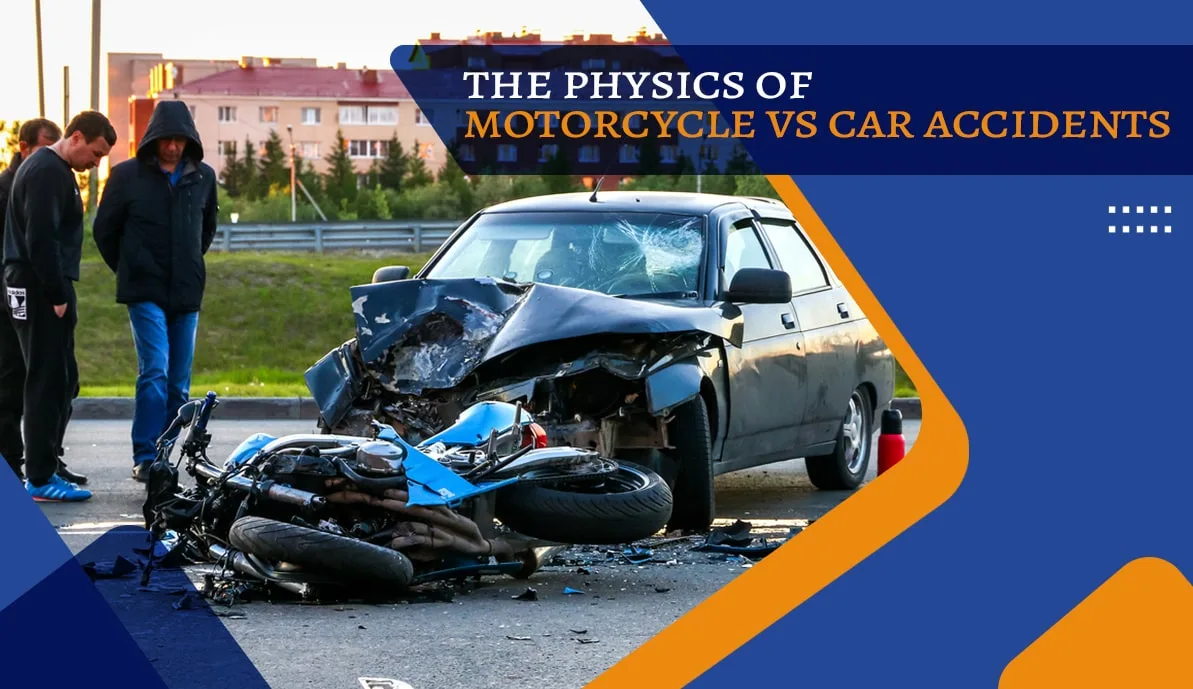
Short answer: motorcycle crashes are deadlier than car crashes because of physics and visibility. A typical car weighs about seven times as much as a motorcycle, the rider has no steel cage, airbags, or seat belt, and drivers often fail to see motorcycles. NHTSA reports that the 2023 motorcyclist fatality rate was almost 28 times the passenger car occupant rate per mile traveled (NHTSA).
The same science matters in a legal claim, because it helps prove how a crash happened and who was at fault. Our motorcycle accident attorneys represent injured riders in Florida, and this is general information, not legal advice.
The Physics of a Motorcycle vs Car Collision
Mass and momentum
A car weighs roughly 3,000 to 4,000 pounds, and a motorcycle weighs roughly 400 to 600 pounds. In a collision the force on each vehicle is equal and opposite, but the lighter vehicle changes speed much more. That is why the rider is often thrown, and why the same crash that dents a bumper can cause life-changing injuries to a rider.
Energy and speed
Kinetic energy rises with the square of speed, so doubling the speed quadruples the energy a crash must dissipate. In a car, crumple zones and airbags absorb that energy. On a motorcycle, the rider’s body absorbs it.
Protection and ejection
Cars distribute crash forces across a steel frame, bumpers, and airbags. Motorcycles have none of these, so riders are often ejected and then suffer secondary impacts with the road, a curb, or another vehicle. A helmet and protective gear reduce injuries but cannot replace the protection of an enclosure.
| Factor | Car | Motorcycle |
| Typical weight | 3,000 to 4,000 lbs | 400 to 600 lbs |
| Crash protection | Steel frame, crumple zones, airbags, seat belts | None; the rider is exposed |
| Ejection risk | Low | High |
| Side impact | Reinforced doors and side airbags | No side protection |
| Stability | Four wheels | Two wheels, so potholes, gravel, and oil can cause a loss of control |
| Visibility to others | Easy to see | Easy to miss in blind spots and at intersections |
| Fatality rate per mile (2023) | 1.13 per 100 million miles | 31.39 per 100 million miles |
Common Motorcycle vs Car Crash Scenarios
- Left turns. A driver turns left across the path of an oncoming motorcycle, often because the driver misjudges the rider’s speed or does not see the bike. These are among the most serious crashes for riders.
- Side (T-bone) impacts. With no side protection, the rider takes the full impact.
- Rear-end crashes. A rider can be thrown forward, with a risk of head and spine injuries even with a helmet.
- Lane changes. A driver changes lanes without checking a blind spot.
- Road hazards. Gravel, potholes, and oil that barely affect a car can cause a rider to lose control.
Injured in a motorcycle crash? Tell us what happened, and an attorney will review your situation for free.
How Science Becomes Evidence in a Motorcycle Claim
Insurers often argue that the rider was speeding, was lane splitting, or “came out of nowhere.” They have some data behind the speeding argument: NHTSA reports that 36% of riders in fatal crashes in 2023 were speeding. That is why independent evidence matters in your case:
- Accident reconstruction. An expert uses skid marks, vehicle and bike damage, and final rest positions to estimate speed, angle, and the point of impact.
- Vehicle data. Many modern vehicles store speed and braking data from just before a crash, and it can be overwritten, so a lawyer can send a preservation request early.
- Visibility evidence. Headlight use, lane position, lighting, and sight lines can show whether the driver had time to see the rider.
- Witnesses and video. Traffic cameras, dash cameras, and bystanders can confirm what happened.
Keep your bike unrepaired until the evidence is documented, because damage patterns often matter more in a motorcycle case than in a car case.
Florida Law That Affects a Motorcycle Claim
- Shared fault reduces your recovery. Under Florida’s modified comparative negligence rule (Statute 768.81), your compensation is reduced by your share of fault, and you are barred from recovering only if you are found more than 50% at fault.
- Helmets. Riders 21 and older may ride without a helmet if they carry at least $10,000 in medical coverage (Statute 316.211). Insurers may still argue that not wearing one made injuries worse.
- Lane splitting. Florida law does not allow a motorcycle to be operated between lanes of traffic (Statute 316.209), and insurers may raise it if the rider passed between vehicles.
- Insurance works differently for riders. Florida’s no-fault PIP system generally does not apply to motorcyclists the way it does to car occupants, which can change which insurance pays and which rules apply to pain and suffering. Have a lawyer confirm how it applies to your crash.
- The deadline is two years. Most Florida negligence claims must be filed within two years of the crash (Statute 95.11).
To learn more, read about what a motorcycle accident lawyer costs and whether to accept a first settlement offer.
Example: How a Motorcycle Claim Can Unfold
This is an illustrative scenario, not a past client case. A rider is going straight through an intersection in Orlando when a driver turns left across his path. The driver tells the insurer, “I never saw him,” and claims the rider was speeding. The rider kept his motorcycle unrepaired, and a reconstruction expert used the skid marks and damage to show his speed was within the limit and the driver had a clear sight line. Early evidence is what keeps the blame from shifting to the rider.
What to Do After a Motorcycle Crash
- Call 911 and get medical care, even if you feel fine.
- Do not give a recorded statement to the other driver’s insurer.
- Preserve your bike, helmet, and gear unrepaired and unwashed, and photograph the scene.
- Get the police report and any witness contact information.
- Talk to a lawyer before you sign anything or accept an offer.
Ready to talk to someone about your motorcycle crash?
The evidence that proves what happened is easiest to find soon after a crash. Fill out the short form and our team will follow up.
Frequently Asked Questions
Why are motorcycle crashes deadlier than car crashes?
A motorcycle is much lighter than a car and gives the rider no steel frame, airbags, or seat belts. In a collision the forces on both vehicles are equal and opposite, but the lighter motorcycle and its rider change speed far more, and the rider’s body absorbs most of the impact.
Is it true that motorcyclists are 28 times more likely to die in a crash?
Per mile traveled, yes. NHTSA reported that the motorcyclist fatality rate in 2023 was almost 28 times the passenger car occupant rate. That figure is based on miles traveled, not on how many trips people take.
Is the car driver usually at fault in a motorcycle crash?
Not always, but many serious crashes involve a driver failing to yield or to see the motorcycle, especially when turning left. Fault depends on the facts, and fault can be shared. In Florida you are barred from recovery only if you are found more than 50% at fault.
Does PIP cover motorcyclists in Florida?
Florida’s no-fault PIP system generally does not apply to motorcyclists the way it does to car occupants, which can change which insurance pays and which rules apply to pain and suffering. Have a lawyer confirm how it applies to your crash.
Do I have to wear a helmet in Florida?
Riders under 21 must wear a helmet. Riders 21 and older may ride without one if they carry at least $10,000 in medical insurance coverage for crash injuries. Insurers may still argue that not wearing a helmet made injuries worse.
How long do I have to file a motorcycle accident claim in Florida?
Two years from the date of the crash for most negligence claims in Florida.