


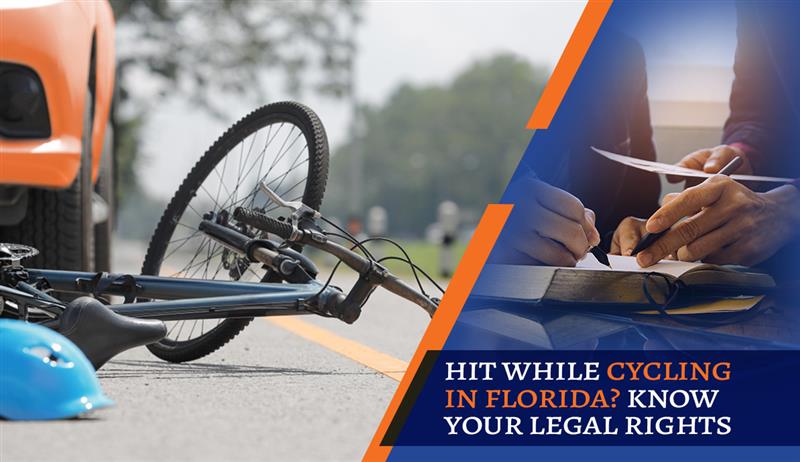
Short answer: yes. If a driver hits you while you are cycling in Florida, you can bring a claim against the driver. Florida gives bicyclists the same rights and duties as drivers, so a driver who turns across your path, passes too closely, or is distracted can be held responsible. Your own medical bills and lost wages are paid first by Personal Injury Protection (PIP), and you can pursue the driver for the rest if your injuries are serious enough. In most cases you have two years from the crash to file a lawsuit.
This guide explains your rights, where the money comes from, what insurers argue against cyclists, and what to do right now. Our bicycle accident attorneys represent injured cyclists, and this is general information, not legal advice.
Your Rights as a Cyclist in Florida
- You have the same rights as a driver. A bicycle rider is granted all the rights and duties of a driver of a vehicle (Statute 316.2065).
- Drivers must give you three feet. A driver passing a bicycle must leave a safe distance of at least three feet (Statute 316.083).
- Drivers must yield when turning across your path, entering an intersection, or leaving a driveway.
The risk is real. State crash data reported in late 2025 shows more than 9,000 bicycle crashes and roughly 200 bicyclist deaths a year in Florida (Florida Phoenix), and cyclists have no protection from the vehicle that hits them, so even low-speed crashes can cause serious injuries.
Who Pays After a Bicycle Crash
Florida is a no-fault state, so payment comes in layers:
- PIP pays first, up to $10,000. It covers 80% of reasonable medical bills and 60% of lost income if you get initial treatment within 14 days (Statute 627.736). If you own a car, or live with a relative who does, that household policy generally applies. Otherwise, the PIP on the vehicle that hit you may cover you if there was physical contact.
- The driver’s liability insurance covers losses beyond PIP. Florida does not require most drivers to carry bodily injury liability coverage, so some drivers have none.
- Your uninsured or underinsured motorist (UM/UIM) coverage, if you or a relative in your household has a car policy, can fill the gap when the driver has little or no insurance, or drove away.
To recover pain and suffering, your injury must meet Florida’s serious injury threshold (Statute 627.737), such as a significant and permanent loss of a bodily function or a permanent injury.
Hit by a car while cycling? Tell us what happened, and an attorney will review your situation for free, including which insurance may apply.
Common Bicycle Crashes and Who Is Usually at Fault
- Left turns and right hooks. A driver turns across a cyclist’s path without yielding. The driver is usually at fault.
- Passing too closely. A driver who leaves less than three feet is violating Florida law.
- Dooring. A driver or passenger opens a car door into a cyclist. See what to do if a car door hits you while cycling.
- Distracted or impaired driving. A driver looking at a phone or driving under the influence is a common cause of serious crashes.
- Hit-and-run. If the driver leaves, see our guide to hit-and-run claims.
For more detail, read who is usually at fault in bike crashes.
What Insurers Argue Against Cyclists
Insurers often try to shift blame to the rider. Under Florida’s modified comparative negligence rule (Statute 768.81), your recovery is reduced by your share of fault and barred only if you are more than 50% at fault. Common arguments include:
- “I did not see the cyclist.” That is not a defense. Drivers have a duty to look.
- No lights at night. Florida requires a white front light and a red rear reflector or light between sunset and sunrise.
- Riding against traffic or running a signal.
- No helmet. Florida requires helmets only for riders under 16, but insurers may argue that not wearing one made your injuries worse.
Evidence That Protects Your Claim
- Keep your bike, helmet, and clothing unrepaired and unwashed.
- Photograph the scene, the vehicle, your injuries, and the road conditions.
- Save ride data from a bike computer or app, and any camera footage. Do not post about the crash or your rides online.
- Get the police report and the contact information of any witnesses.
- Keep every medical record and bill, and note any missed work.
What to Do After a Crash
- Call 911 and ask for medical help and a police report.
- Get medical care within 14 days, even if you feel fine, so PIP applies.
- Do not give a recorded statement to the driver’s insurer. Adjusters often call within hours.
- Do not accept a quick offer before you know the full cost of your injuries.
- Talk to a lawyer before you sign anything.
Example: How a Cyclist’s Claim Can Unfold
This is an illustrative scenario, not a past client case. A cyclist is riding in a bike lane in Winter Park when a driver turns right across the lane and knocks her down. The driver tells the insurer, “I never saw her.” The cyclist kept her helmet and bike unrepaired, saved footage from her handlebar camera, and got treated within 14 days, so her household PIP applies. The driver turns out to carry no bodily injury coverage, so her uninsured motorist coverage becomes the main source for the rest of her claim. Early evidence is what keeps the insurer’s blame arguments from sticking.
How Long Do I Have to File?
For most negligence claims in Florida, you have two years from the date of the crash (Statute 95.11). Learn what bicycle accident settlements involve, read about e-bike crashes, or estimate your claim with our settlement calculator.
Ready to talk to someone about your bicycle crash?
Evidence and witnesses are easiest to find soon after a crash. Fill out the short form and our team will follow up.
Frequently Asked Questions
Can I sue if a car hits me while I am cycling in Florida?
Yes. Florida gives bicyclists the same rights and duties as drivers, so if a driver’s negligence caused the crash, you can bring a claim for your medical bills, lost income, and, if your injury meets Florida’s serious injury threshold, pain and suffering.
Who pays my medical bills first after a bicycle crash in Florida?
Personal Injury Protection (PIP) generally pays first, up to $10,000, regardless of fault, if you get treatment within 14 days. If you own a car or live with a relative who does, that household policy generally applies. Otherwise, the PIP on the vehicle that hit you may apply if there was physical contact.
What if the driver has no insurance or drove away?
You may be able to claim through uninsured motorist (UM) coverage on a policy in your household. Florida does not require most drivers to carry bodily injury liability coverage, so this is common. Report the crash to police right away.
Does it matter if I was not wearing a helmet?
Florida requires helmets only for riders under 16. For adults, an insurer may still argue that not wearing a helmet made your injuries worse, but that is an argument, not a bar to your claim.
What if I was partly at fault for the crash?
You can still recover, but your compensation is reduced by your share of fault. Under Florida’s modified comparative negligence rule, you are barred from recovering only if you are found more than 50% at fault.
How long do I have to file a bicycle accident claim in Florida?
Two years from the date of the crash for most negligence claims in Florida.